Sunday, June 21, 2015

Itadakimasu

Like so many things in Japan, eating a meal is not simply eating a meal.  It is a full sensory experience – pleasing for the eyes, ears, and palate.  Japanese food is not always the most flavorful, there is a definite lack of spices in traditional food, but it is prepared so that the flavors of the ingredients compliment and accentuate the overall taste.  It is as much a feast for the eyes as it is for the stomach.  Food is served like edible pieces of art.  From dinnerware design to intricate combinations of colors in the food itself, even eating at an izakaya is more like a three star restaurant.

Depending on the restaurant or bar, the service and type of food will change.  At izakayas and fancy restaurants, everything comes in courses.  Small dishes you are expected to share.  Unlike America, where everyone orders their own plate, dining in most Japanese restaurants is more family style.  This creates a sense of camaraderie and community among diners.  As does the abundance of alcohol.  It seems a typical Japanese meal is not complete without beer. A fact which makes the lush in me very happy.  And so the hours pass quickly as you eat, drink, and laugh with amazing new friends.  Food and merriment are international languages after all.

On beautiful plate after another arrives and is quickly consumed.  In the end, it is almost like they care more about presentation than taste.  I won’t complain though, as long as I don’t have to wash all the little dishes. 

Dining in Japan is a truly wonderful experience.  It is a balance between cultural nuance and the soul of humanity I came here to find – at once utterly Japanese and completely human.  The food may be different, the attention to presentation beyond compare, but the sound of laughter and friendship could be found at any dining table in any corner of the globe.

Gochiso sama deshita!

Wednesday, June 17, 2015

Taking time to see the trees in Japan

Katsura Imperial Villa, Kyoto
I am not sure why, but can’t seem to see the forest for the trees has always been my favorite idiom.  It was in an SR71 song, a band I feel was quite underrated.  I remember hearing it and then finding out it was an idiom a little while later.  Maybe it is the imagery of trees that makes me like it.  Maybe it is the message that sometimes you need to look at the bigger picture instead of focusing on the details.  Maybe it is because my personality swings from big picture to detail oriented depending on the day, position of the moon, color of my socks, etc.

But in Japan I think this idiom should be switched around – can’t see the trees for the forest.  Everything in Japan seems to have a simple beauty – clean lines, open space, seemingly effortless elegance through minimalism.  It isn’t till you get closer that you realize how wrong you were.  While a garden may look simple, it is really an intricate design based on years of careful pruning and planning.  Every tree, path, bench, and pond has been meticulously designed to present the perfect view.  The buildings with their open layout and stark building materials hide intricate details just waiting for the discerning eye.  Food is prepared and present with a degree of artistry and an eye for detail Da Vinci and Michelangelo would be proud of.

I think this phenomenon is something uniquely Japanese.  The attention to detail is characteristic of their meticulous nature and well developed sense of aesthetics.  But they are also a modest people who downplay their achievements, effort, and skills, hiding them in the forest of the overall picture.  But if you take the time to get close, to focus in on the trees, you will realize how truly amazing and intricate every aspect of Japanese culture is.  To use another idiom, don’t judge a book by its cover.  In Japan, you will find the wondrous hiding in the details.  Although the forest is breathtaking too.

Thursday, June 11, 2015

Discovering the Heart of Japan on the Open Ocean

I have been here over eight months and I feel I am better able to understand modern day Japanese people.  Each day I learn a little more, peel back the lotus petals a little further, to reveal the heart of Japan.  But one experience taught me more in a few short hours than most of my other adventures combined.  If you want to see real Japanese people, take an overnight ferry.

Anata finally had a chance to visit me between the end of one school year and the start of the next.  We planned a whirlwind vacation that would show him some of the best things Japan has to offer.  Our itinerary included temples, shrines, gardens, restaurants, volcanoes, and sakura.  Two weeks of my best of Japan.  We would spend a few days in Kyoto soaking up the culture of the old Capital, a short stint in Osaka to meet my friends, then ride the sakura wave up Kyushu from Kagoshima to Kumamoto.  Every part of the trip turned out to be amazing.  Anata found it easy to understand why I have been so captured by this beautiful country.  But the part that struck both of us as the most Japanese wasn’t even meant to be anything more than a place to rest our head for a night while we were being transported from point A to point B.


When we decided to go to Kyushu, we needed to find a way to get there.  The train was very expensive.  Flying was reasonably priced, but getting to the airport seemed daunting and wasteful.  Instead we opted to take the overnight ferry from Kobe to Miyazaki.  This would kill two birds with one proverbial stone – we could travel and save on a hotel for the night.  We waffled a little deciding which class of accommodation to book.  In the end we went with the lowest because travel wa mecha takai desu yo!

Little did we understand the adventure we were getting ourselves into.  When we stepped onto the boat and were guided to our pallets for the night, we began to second guess our choices.  The third class accommodation was essentially a huge room for about two hundred people.  We would be sleeping on a thin, single futon with only a fleece blanket and a pleather covered foam rectangle for a pillow.  There was no way of partitioning ourselves off from everyone, achieving any sort of privacy, or, I feared, comfort.  I couldn't help thinking this was only mildly above the steerage class on the old ocean liners or the horrid conditions on even earlier ships.  As I unfolded the futon, I was having serious doubts.

Smiling to mask the fear
Home sweet home?
It was at this point we met our neighbors for the evening - a father and his two sons.  The older boy reminded me of some of my fifth grade students.  The younger one... Let's just say I nicknamed him Luffy within a matter of minutes.  He was a four year old ball of energy.  Others were filing in, looking for their own meager accommodations, so we stored our bags in the cubby provided, smiled at our new neighbors, and decided to go exploring.  
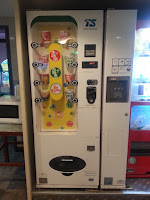

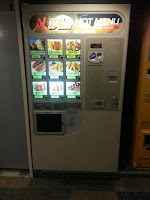
The ship, though older and smaller than other cruise ships I have been on, my only frame of reference, was surprisingly well equipped.  There was a sento, a restaurant and dining room, and the fantastic array of vending machines I have come to expect from Japan.  I was especially impressed with the ramen and hot food machines (though getting a hot dog and fries from it seemed a little unsettling).  I had not seen many food vending machines at this point, just bread really, so these were new.  However, I was relieved when Anata opted for the restaurant over the vending machines.
After a filling dinner, we decided to call it a night.  We weren't especially tired, but we didn't really have any other options.  There wasn't a magic show or live music on this ship.  We didn't bring towels so the sento was out too.  Instead we headed back to our futons.  And this is when we realized just what a culturally interesting adventure we were on.

The room was full of people.  We were some of the first passengers on, so we didn’t see everyone arriving.  But despite the large amounts of people, it didn't feel crowded.  Each group had formed their own space within the larger room and were quietly enjoying themselves.  A high school volleyball team stretched out in the top corner of the row next to us.  One boy was already asleep with his arm thrown across his face.  Three others played cards, occasionally raising their voices in triumph or defeat.  Several more were tethered to the power outlet as they stared intently at their various electronic devices, their faces illuminated by blue and white lights.  Families and groups traveling together munched on food they had brought with them.  There were store bought bentos as well as onigiri and other food prepared at home.  It all looked really delicious.  They drank their Asahi and chatted, sitting cross legged or seiza on the floor.  In one corner a TV was on.  It seemed to be a popular drama as many people were intently watching.  Children flitted around the room, moving between adults and groups, playing games and making friends.

Luffy had returned.  There was no sign of his father or big brother.  He rolled around on the futon next to ours.  Then he disappeared for a few minutes only to come running back.  Soon he had endeared himself to an older man with a place near us.  They started laughing and playing.  The ojiichan held Luffy by the arms while the little boy did flips.  Onisan, the older brother, appeared after a while.  He tried to get Luffy into bed.  It worked for about five minutes.  Then Luffy was back up and gone.

As we watched, I realized this was the perfect microcosm of the Japanese mind; the collective society mentality, the ability to create personal space in a public setting, the tolerance and communal approach toward children.  This was Japan in a nutshell.  I had seen these traits and behaviors many times before, been struck by their difference from my own culture, but it was different to see them all going on simultaneously in the same small place.


Eventually the TV was turned off and the cabin lights dimmed.  As amazing as watching the interactions was before bed, sleeping in a room with almost two hundred people, or rather trying to sleep, was far from pleasant.  Between snoring, coughing, and the constant sound of the engine below us, there was very little sleep that night.  Anata and I were up early, feeling exhausted.  Anata more so than I since Luffy somehow confused his leg for a pillow in the night.  I gently pulled Anata’s blanket from Luffy’s tiny hand as the Ojiichan that had been playing with him the previous night smiled knowingly.

I will definitely think twice about taking the overnight ferry again, but I am glad I did.  It was a wonderful illustration of Japanese culture and social structure.  It was something Anata would never have understood without seeing it in this setting.  Still, the lack of sleep got our Kyushu adventure off to a rough start.

Sunday, May 31, 2015

A trip through Studio Ghibli

Taking the train from Osaka to Wakayama is like taking a trip through a Studio Ghibli filmography.

Buildings and highways are quickly replaced with rice fields and mist shrouded mountains.  You pass the old house and forested hill where you know Totoro is sleeping soundly.  You snake along the coast, your eyes locked on the surf, looking for Ponyo racing along with you.  Another turn reveals a stretch of beautiful coast hemmed in by dark green mountains.  Reluctantly turning away from the vast expanse of the ocean, you glance inland to see if you can spot the flags of Coquelicot Manor, Umi’s home.  Your gaze flows uphill toward the forested peaks behind.  You wonder if you got off the train at the next stop and wandered these beautiful mountains if you could find Chihiro’s gateway.  Maybe another day. The train pulls away from the coast, back toward the countryside, where scarecrows dot the gardens, and you wonder if any of them have a turnip for a head.

The train speeds on and soon you have reached your destination.  You must leave the world of Ghibli behind, but not too far.  Totoro’s mountains are just a few steps outside your door, after all.

Friday, May 22, 2015

Making a home

Because Wakayama City is much smaller than Osaka, finding housing is a bit more difficult.  I was unable to find another share house, so I was forced to move into an apartment.  While the process wasn’t the easiest, I was lucky and found a really helpful employee at one of the few gaijin housing agencies.  Her English was great and she did so much to help me find the perfect place.

Still, as I stood in the middle of my bare new apartment, it was a little overwhelming.  Living on my own was exciting, but the challenge of making this stark place into a home was daunting.

I started with unpacking the one suitcase I brought with me.  Mostly clothes.  Then, many trips back and forth to Osaka later, my possessions slowly started to find their place in my new space.  Buying dishes, household goods, and little bits and pieces of my new life helped a little, but the space was still not a home.  Otose’s place was full of warmth, laughter, and the rich smell of tatami.  This new place was bright (made even more so by the plain white walls), but it lacked the warmth of a home.  However, work started, the ball of life started rolling, and there was little time to worry about it.  I had a space to sleep, cook, and exist.  Toriaizu ii desu.

Days turned to a week, and I found myself getting more comfortable in my new apartment.  I managed to procure the essentials (and some not so essentials).  I was settling in.  But home was still Osaka.  It even said so on Google Maps.  Then one day, with the simplest thing, it changed.

Walking home from the grocery, I passed by one of the many large gardens near me.  This one has a small table at the entrance where they put out produce for a hundred yen.  This day they had onions, but also a blue plastic bucket of fresh cut bouquets. 

Smiling, I bought a bouquet with daisies, freesia, and an assortment of purple, orange, and white flowers.  I had no vase, so I put this vibrant treasure in a plastic Gintoki cup and placed it on my table.  Suddenly my apartment became my home.

Growing up, Otosan had always kept the yard beautiful.  It was his job, but also his passion.  There were always flowers in spring and summer.  Anytime there was a party or company came for a visit, or just because the flowers were exceptionally beautiful, he would make arrangements and put them all over the house – the kitchen table, the bathroom, my bedroom.  It was always something that made me happy.  One of the little things that made our house a home.

I sat down at my computer, next to the little bunch of flowers, and updated the home location on Google Maps.

Wednesday, May 20, 2015

Reflections on rain

One day it started raining, and it didn't quit for four months. We been through every kind of rain there is. Little bitty stingin' rain... and big ol' fat rain. Rain that flew in sideways. And sometimes rain even seemed to come straight up from underneath. Shoot, it even rained at night...
                                                                                                                                            -Forest Gump

As I sit through yet another rainy afternoon, I reflect on the many types of rain, and their corresponding seasons that I have experienced in my brief time here.  Japan is not always rainy, but there is a reason umbrellas appear so frequently and play such a significant role in their history, literature, and entertainment.

I arrived in summer, the end of the rainy season.  Even before the heavens opened up, it felt like you were underwater.  Cicadas seemed to be the only things alive, their voices carried on the palpable air.  You could watch the storm build, white clouds piling higher and higher against clear blue skies.  Like the ice cream you were too hot to move for, but desperately wanted.  Then, in the afternoon a gust of wind would suddenly clear the hot stuffy air and you knew it was time.  If you were outside, you dashed for the nearest building.  If you were inside, you just settled in to watch and listen.  The rain was the only thing loud enough to drown out the cicadas.  Soon the roar would subside then die out all together.  For a brief moment the air would be cool and fresh before the heat started to rise again and the whole process repeated.

I am not sure exactly when the rainy season ended, but summer turned to fall and the downpours subsided.  Now the rain came slower and colder.  It lingered for hours when it came, keeping you inside, forcing you to acknowledge the coming winter.  Rainy days were few, but they made you shockingly aware of how unprepared you were for being cooped up all winter.  Fall rain smelled of tatami and damp leaves.  Heavy and rich.  Sticking to your hair and clothes.  Filling your head with memories of summer.  But where the stifling heat of summer had driven you out into the rain, the cool breezes of fall encouraged you to stay indoors with a cup of tea and a good book, listening to the gentle patter of rain on the window.  This was a time for naps, day dreaming, and being alone.

Winter rain was the worst.  A cold that seeps into your very bones, even if you don’t get wet.  Clouds hung low, concealing the tops of mountains and skyscrapers.  It seemed the sun was gone for good as one rainy day bled into another.  Dampness clung to everything, even your soul, as the endless drizzle washed away the very colors around you.  Winter rain was a world of grays.  People shuffled with heads down under black umbrellas.  You dreaded being outside, but it seemed the rain could even follow you inside through single pane windows and thin walls.  The smell of wet wool swirled around you as the wind tugged at your umbrella.  You prayed for spring fearing it would never come.

But eventually the rain grew less cold.  The sun returned.  Spring was coming.  The days of endless rain somehow seemed more hopeful.  Maybe it was the fact they happened less frequently.  Maybe it was because in the brief moments between rains, you could feel the air getting warmer and warmer until the rain was no longer cold at all.  You lingered in the showers, rather than rush on to the next building.  You felt yourself growing, just like the buds on the trees and the bulbs still under the ground.  You soaked up the warm rain and your soul began to bloom with the spring.  The smell of fresh earth.  The first bird songs ringing through rain cleaned air.  Where winter rain bathed the world in grays, spring rain intensified the colors around you.  Greens were greener, reds redder, pinks pinker.  Raindrops clung to new flowers like jewels sparking in the sun.  Everything felt fresh and clean.  The staleness of winter melted away in the warm rain, soaking into the ground to give strength to new life.


The days grow longer and hotter.  The cicadas start to sing.  You watch the first summer storm building in the distance.

Monday, May 18, 2015

New beginnings in Wakayama

At the end of last school year, I was faced with a tough decision.  I would not be able to stay in Osaka, as there wasn’t a job for me.  However, I could move to an unknown destination in Wakayama Prefecture and stay in Japan for another year.  While I obviously decided to move, it was not an easy choice.  The information I could find on Wakayama didn’t paint it in the best light.  Largely rural (by Japanese standards), it was an area hard hit by Japan’s economic troubles and shifting populations.  While rich in natural beauty, it didn’t seem like a really great place to spend the next year.  Good thing I don’t believe everything I read on the internet.

I was placed in Wakayama City, the area I was hoping for when I reluctantly agreed to stay with my company.  Although there are signs of economic hardships, it is in no way the Detroit sized problem the internet made it sound.  And as far as the lack of bright lights and constant distractions, Wakayama more than makes up for it with abundant natural beauty, clean air with a hint of the sea, and a slower pace of life.  Here people spend Saturdays fishing as a family, working in huge (by Japanese standards) gardens, or enjoying barbeques on the beach.  It is a much simpler existence filled with early morning bird songs, dark nights full of stars, and people chatting the evening away on balconies and porches.

It is also a whole different kind of Japan.  The streets are narrow and they loop, zigzag, and dead end.  Cars have to wait, since many places aren’t wide enough for two to pass.  Ancient houses hide long family histories and immaculate Japanese style gardens behind high walls, glimpsed through always open gates.  Fresh produce and flowers are everywhere; sold in grocery stores and at little local stands where you just leave your money in a can.  In many ways, it is the polar opposite of Osaka.  This is a good thing.  It will make my transition back to South Dakota so much easier when I finally return.

Wakayama is a hidden gem, it seems.  Filled with all the things I never realized Osaka was missing, but still close enough to Osaka for a quick trip to eat at my favorite restaurants or to spend a day with my friends.  In my short time in Wakayama many people have asked me to compare my new home with my old one.  I tell them it is impossible.  Wakayama wa Wakayama.  Osaka wa Osaka.  It can’t be done.  But one visit and many of my Osaka friends fall in love with this quiet city.  The same way I did.  There are things here I never found in Osaka – darkness, thrift stores, amazing pizza, and the stunning natural beauty of the Japanese coast.  But I have also been able to find many of the things that made Osaka so comfortable – friendly people, welcoming hole in the wall restaurants, and an easy, laid back style of living.

I have only been here a few weeks, but I have a feeling I am in the right place at the right time yet again.  I think living here will challenge, inspire, and strengthen me.  It will give me the time and peaceful environment I need to focus on my personal growth.  It will force me to remember how to do housework and otherwise be a responsible adult (Otose spoiled me with utilities included and cleaning of common areas).  The sights, smells, and sounds will ignite my imagination and rejuvenate my spirit.  There are things I will miss about Osaka, mostly the amazing people I gratefully call my friends, but I will make the most of this new home.  Ikimashou!